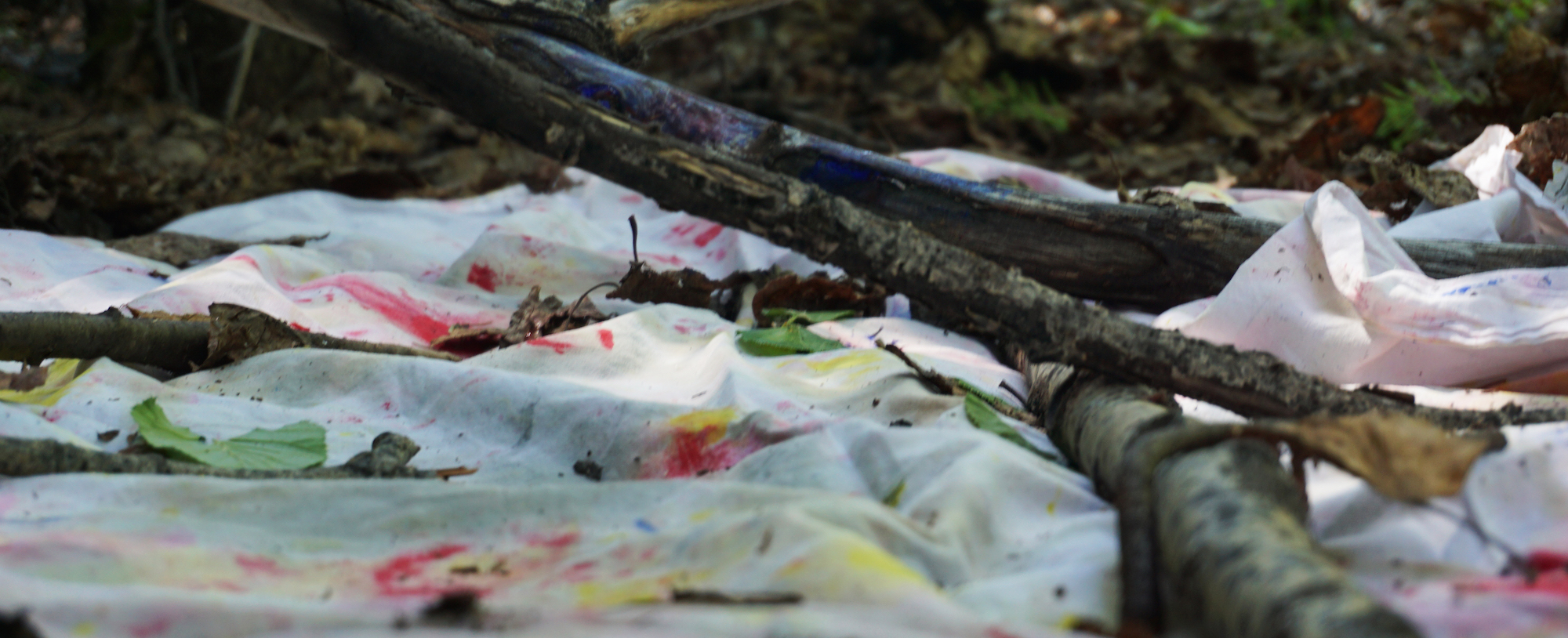
Drawing from a range of disciplines, this course invites educators to rethink waste materials in early childhood spaces.
The first three course content modules – Relationships with Materials, Common Worlding, and Materials and Waste – will provide the framework for understanding materials and waste as active participants in early childhood education. Through all four course content modules, educators will connect with others who want to rethink waste creatively.
By participating in this course, educators will also be supported to think locally and converse with their colleagues to reimagine waste flows in their context.
* PLEASE NOTE: This course is only available for educators in BC.
The Spring cohort will run March 30 to June 21, 2026. Spring cohort registration will be open March 11 through March 25.
A professional development certificate for 22 hours will be provided for completing this course. This requires uploading assignments for 4 Modules, attending one live Zoom session for the Introduction and one live Zoom session for each of the 4 Modules, and completing a short end of course survey. Partial completion hours will not receive a professional development certificate.
FAQs
This is a 12-week course worth 22 hours of professional development. Each course content module is 3 weeks and should take approximately 5.5 hours to complete.
Modules 1 -3 each involve:
- about 4 hours of independent emgagement, and
- a 1.5-hour synchronous (live) Zoom gatherings in Week 3.
Module 4 involves:
- about 3 hours of independent engagement with focus on “living with plastics” throughout the module, and
- a 1.5-hour synchronous gathering.
There is also a short (30-minutes) introductory synchronous (live) gathering at the beginning of the course to go over expectations and help us begin as a group. The introduction Zoom gathering is a companion to the brief Introduction module, which participants are expected to read (about 30-minutes of independent engagement).
Each three-week module includes course content that participants engage with both independently and collectively. Course content may include:
- reading module information
- reading a book chapter or article
- watching a video
- listening to a podcast
- exploring a website
Participants will:
- Watch/read and engage with the course content during Week 1,
- experiment with materials during Week 2,
- upload documentation of their material encounter by Sunday at midnight to access the synchronous gathering,
- attend one live gathering in Week 3 (Thursday evening or Saturday morning), and
- complete the short reflection prompts after the gathering to move to the next module.
Documentation can take many forms — photographs, short video or audio clips (when possible), written notes, or sketches.
Participants are also invited to keep a journal to record their thinking, questions, and responses to readings and material encounters. Journals are not uploaded; instead, they may support Week 3 dialogue and the reflection prompts.
- A profile on the EYPD Hub
- Access to a computer, tablet, or smartphone and internet
- A working camera and microphone for the synchronous Zoom gatherings
- A notebook (or a digital alternative) for journaling
- Access to a camera for taking photos of material encounters
Once you register, you will immediately have access to the Introduction Module. Module 1 (Relationships with Materials) will open on your cohort’s start date.
To move from one module to the next, you must:
- complete the module’s lessons,
- upload your documentation by the end of Week 2,
- attend a Week 3 gathering, and
- complete the short reflection prompts in the module after the gathering.
All synchronous gatherings take place on Zoom. The meeting link will be posted in your cohort’s Discussion Room at the start of the course.
Documentation and reflections are typically reviewed within 2 business days. Submissions can be made at any time, but work is not reviewed during evenings, weekends, or holidays.
In this course, feedback is offered broadly and collectively during the synchronous gatherings, where we think together with the documentation participants bring. These conversations help us notice themes, questions, and possibilities across the group’s work.
Because of this collective approach, individual written feedback on each submission is not provided through the course site. If a participant’s work raises a concern or requires clarification, the course leader will reach out directly.
- An accessibility widget is available on the right side of your screen.
- All text is screen-reader compatible.
- Images and diagrams include alt-text.
- All videos include closed captions.
- The accessibility widget includes a language switcher.
- The course was created with Universal Design for Learning principles in mind, offering materials in text, audio, video, and interactive formats.
Certificates are provided at the end of the course once all module activities and the course evaluation have been completed. Partial-completion certificates are not available.
Your cohort’s group leader will be available to support you. Their contact information will be shared on the course start date.
If you have questions before then, please email ecpn@uwo.ca
Course Content